HAWAIIAN MAMAKI
Find out more about this miracle native Hawaiian Plant
Everything you need to know about mamaki
Where does Mamaki grow?
Māmaki (Pipturus albidus) is a plant native to the Hawaiian Islands. It grows naturally in mesic and wet forests, from relatively low elevations to mountainous areas reaching roughly 6,000 feet. The plant can be found on Kauaʻi, Oʻahu, Molokaʻi, Lānaʻi, Maui, and Hawaiʻi Island, where different growing conditions can influence the appearance of the leaves and plants.
Is Mamaki only grown in Hawaii?
Māmaki is considered endemic to Hawaiʻi, meaning Hawaiʻi is its natural native home and the only place where it occurs naturally. The plant may potentially be cultivated elsewhere under suitable conditions, but naturally occurring Pipturus albidus is uniquely Hawaiian. This connection to the islands is one reason authentic Hawaii-grown māmaki has become such a distinctive local botanical product.
How was Mamaki traditionally used in Hawaii?
Māmaki had several uses in traditional Hawaiian life. Its leaves were prepared as an herbal drink and were traditionally associated with restoring strength and general well-being. The fruit also had traditional uses, while the plant's strong inner bark was used to make kapa cloth and its wood was used for tools such as kapa beaters. Māmaki was therefore much more than a tea plant, it had medicinal, practical and cultural uses.
What are the health benefits of Mamaki tea?
Māmaki leaves naturally contain plant compounds with antioxidant activity, which is one of the most researched characteristics of the plant. Research has also investigated māmaki for potential anti-inflammatory, antimicrobial, and other biological properties.
Traditionally, māmaki tea has been consumed for general wellness and has been associated with digestive, cardiovascular, and metabolic health. However, many traditional uses still require stronger human clinical research, so māmaki tea is best enjoyed as part of a balanced wellness routine rather than considered a treatment for a medical condition.
Does Mamaki tea have caffeine?
Pure māmaki tea is naturally caffeine-free. Māmaki is an herbal infusion rather than tea made from the caffeine-containing Camellia sinensis plant, which is used to produce traditional black, green, white, and oolong teas.
This makes māmaki a good choice for people looking for a naturally caffeine-free herbal drink that can be enjoyed throughout the day or in the evening.
If māmaki is part of a blend, check the other ingredients because blends containing traditional tea leaves may contain caffeine.
What does Mamaki tea taste like?
Māmaki has a gentle herbal flavor that is often described as earthy, smooth, slightly nutty, and naturally mild. Unlike some stronger herbal teas, it generally does not have an intensely bitter finish. Some people also notice a subtle natural sweetness.
Its mild character makes māmaki enjoyable on its own and easy to combine with other herbs such as ginger, hibiscus, peppermint, lemon balm, rosehip, or lemongrass.
How do you make Mamaki tea?
Place dried māmaki leaves in a cup or teapot and pour hot water over them. Allow the leaves to infuse, then strain the tea before drinking.
A practical starting point is approximately 2 grams of dried māmaki leaves per cup of water. You can adjust the amount depending on how light or strong you prefer your tea.
Māmaki can be enjoyed plain or served with honey, lemon, or other herbs.
How long should Mamaki tea steep?
For a balanced cup, allow māmaki leaves to steep for approximately 5–10 minutes. A shorter infusion creates a lighter and more delicate flavor, while a longer steep produces a stronger herbal taste.
Whole māmaki leaves naturally vary in size, so steeping time does not need to be exact. Adjusting both the amount of leaves and the brewing time makes it easy to find the strength you prefer.
How much Mamaki tea should I use per cup?
Start with approximately 2 grams of dried māmaki leaves per 8-ounce cup of water. If you do not have a kitchen scale, you can use several dried leaves instead, although the exact amount will vary depending on their size.
For stronger tea, add a little more māmaki. For a lighter infusion, reduce the amount of leaves or use more water.
Can you drink Mamaki tea every day?
Māmaki can be enjoyed as part of a regular herbal tea routine, and its naturally caffeine-free character makes it suitable for people who prefer to avoid caffeine.
There is currently no scientifically established recommended daily intake specifically for māmaki tea. Anyone who is pregnant, breastfeeding, taking medications, or managing a medical condition should consult a healthcare professional before regularly consuming herbal products.
How much Mamaki tea can you drink a day?
There is no scientifically established standard daily dosage for māmaki tea. For general beverage use, 1–3 cups throughout the day can be considered a moderate amount rather than a medical dosage.
Individual tolerance can vary, and drinking larger quantities does not necessarily provide additional benefits.
Can you cold brew Mamaki tea?
Yes. Māmaki can be prepared as a cold-brew herbal tea. Add dried māmaki leaves to cold water, place the container in the refrigerator, and allow the leaves to infuse for several hours or overnight.
Strain the leaves before serving. Cold brewing creates a smooth and refreshing infusion and works especially well when preparing a larger pitcher of māmaki iced tea.
Can you reuse Mamaki tea leaves?
Yes. Whole māmaki leaves can often be steeped more than once. A second infusion will generally have a lighter flavor because some of the flavor and soluble plant compounds have already been extracted during the first steep.
For the second infusion, add fresh hot water and allow the leaves to steep slightly longer. If the wet leaves will not be reused immediately, refrigerate them rather than leaving them at room temperature for an extended period.
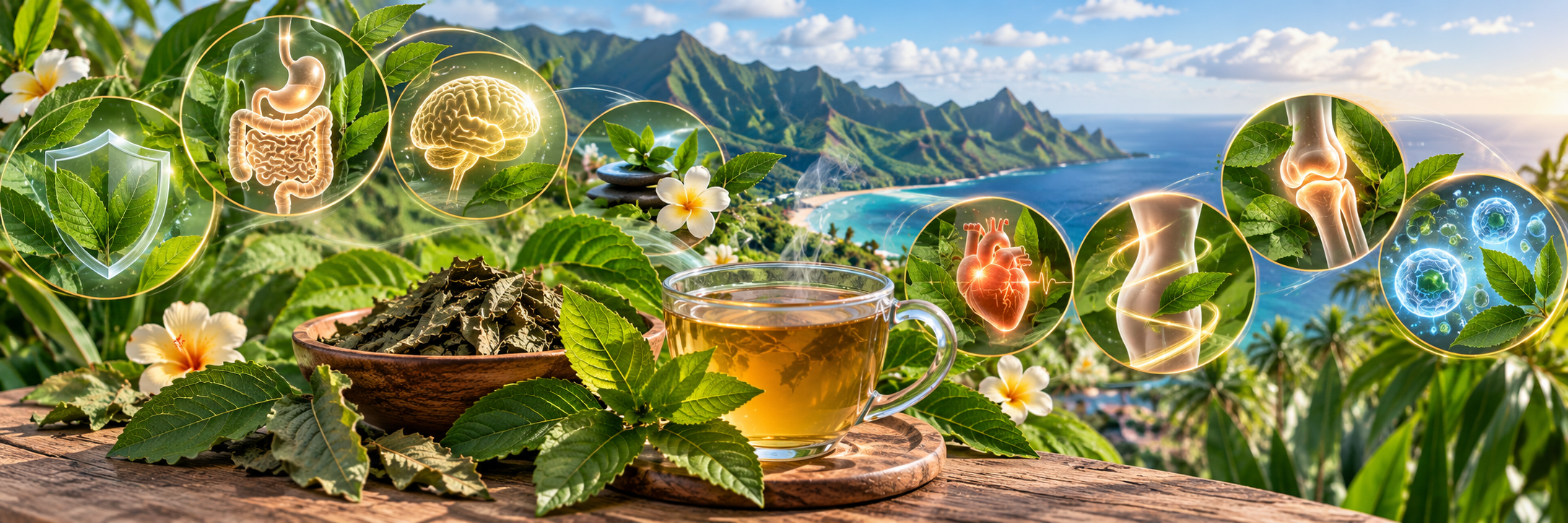
MEDICINAL PROPERTIES OF MAMAKI
What are the side effects of Mamaki tea?
Māmaki tea has a long history of traditional use in Hawaii, but detailed scientific information about its possible side effects is still limited. There is currently no well-established list of common adverse effects associated specifically with drinking māmaki tea.
As with any botanical product, individual reactions are possible, particularly when consuming larger amounts or trying the herb for the first time. People who are pregnant, breastfeeding, taking prescription medications, or managing a medical condition should speak with a healthcare professional before making māmaki a regular part of their routine.
Does Mamaki tea help with cholesterol?
Māmaki has traditionally been used in Hawaii in connection with cardiovascular wellness, including maintaining healthy cholesterol levels. Its leaves contain several naturally occurring plant compounds, including catechins, rutin, and chlorogenic acid, that have attracted scientific interest because of their antioxidant properties.
However, there is not enough human clinical research to say that drinking māmaki tea lowers cholesterol. It can be enjoyed as part of a healthy lifestyle, but it should not be considered a replacement for cholesterol medication, dietary changes, or medical treatment.
Is Mamaki tea good for blood pressure?
Traditional Hawaiian use of māmaki includes its association with cardiovascular health and healthy blood pressure. The plant also contains naturally occurring minerals and polyphenols that have encouraged researchers to investigate its potential health properties.
At this point, there is not enough clinical evidence in humans to establish māmaki tea as a treatment for high blood pressure. Anyone taking blood-pressure medication should also be cautious about using herbal products specifically for the purpose of changing blood pressure.
Does Mamaki tea help with digestion?
Māmaki has traditionally been consumed to support digestive comfort, and historical uses of the plant include preparations for stomach and digestive concerns. It has also been described in traditional herbal use as having mild laxative properties.
For everyday use, māmaki provides a gentle, caffeine-free alternative to coffee and conventional caffeinated tea. Scientific research has not yet established a specific digestive effect or recommended amount for digestive support, so traditional use and proven medical benefits should be considered separately.
Is Mamaki tea good for inflammation?
There is interesting early research surrounding māmaki and inflammation. Laboratory studies of māmaki extracts have demonstrated activity involving biological pathways associated with inflammatory responses, including NF-κB signaling and nitric oxide production.
These findings make the plant an interesting subject for further research, but laboratory results are not the same as demonstrating an anti-inflammatory effect in people drinking māmaki tea. More human studies are needed before specific anti-inflammatory benefits can be confirmed.
Does Mamaki tea help with weight loss?
There is currently no strong scientific evidence showing that māmaki tea directly causes weight loss or burns body fat. Claims describing it as a weight-loss treatment therefore go beyond what research has established.
What māmaki does offer is a naturally caffeine-free herbal beverage that can be consumed without added sugar or calories from sweeteners. Replacing high-calorie sweetened drinks with unsweetened herbal tea can fit naturally into a balanced weight-management routine, but the tea itself should not be expected to produce weight loss.
Is Mamaki tea good for sleep?
Māmaki contains no natural caffeine, which makes it suitable for an evening cup for people who prefer to avoid stimulating beverages before bedtime. Traditionally, māmaki has also been associated with relaxation and stress support.
That does not mean māmaki has been scientifically demonstrated to work as a sleep aid. Its biggest practical advantage at night is that it provides a warm, caffeine-free herbal drink. For a more relaxing evening blend, māmaki is also commonly paired with herbs traditionally associated with bedtime routines, such as chamomile, lavender, or lemon balm.
What antioxidants are in Mamaki tea?
Māmaki leaves contain several notable polyphenolic compounds. Researchers have identified (+)-catechin, rutin, and chlorogenic acid among the important antioxidant-related compounds naturally present in the leaves.
These compounds belong to groups of plant chemicals studied for their ability to interact with free radicals and oxidative processes. Research has also measured antioxidant activity in brewed māmaki tea, although the exact concentration can vary according to the leaves, processing method, preparation, and brewing conditions.
Is there scientific research on Mamaki tea?
Yes. Māmaki (Pipturus albidus) has been studied scientifically, particularly for its phytochemical composition and biological activity. Researchers have examined its antioxidant compounds, including catechin, rutin, and chlorogenic acid, as well as potential anti-inflammatory, antimicrobial, antiviral, and other biological properties.
The important distinction is that much of the existing research is laboratory-based rather than large-scale human clinical research. Scientific studies support continued interest in māmaki as a Hawaiian botanical, but many of the health benefits traditionally associated with the tea have not yet been confirmed through controlled human trials.

WHERE TO BUY MAMAKI
Because māmaki is endemic to Hawaii and grows naturally in the islands’ moist forests and mountain regions, genuine Hawaii-grown māmaki is a relatively limited botanical product.
When buying māmaki, look beyond the name on the package. Good-quality tea should contain clean, properly dried leaves with no unnecessary fillers, artificial flavors, or added ingredients unless you are intentionally purchasing an herbal blend. The origin and handling of the leaves are especially important if you are looking for authentic Hawaiian māmaki.
Hawaiian Wonders is one source for premium Hawaii-grown māmaki. The company offers carefully selected dried māmaki leaves for brewing as a pure herbal tea, along with māmaki-based herbal blends. For customers looking specifically for authentic Hawaiian mamaki, choosing leaves that are grown and prepared in Hawaii is one of the most important things to consider.